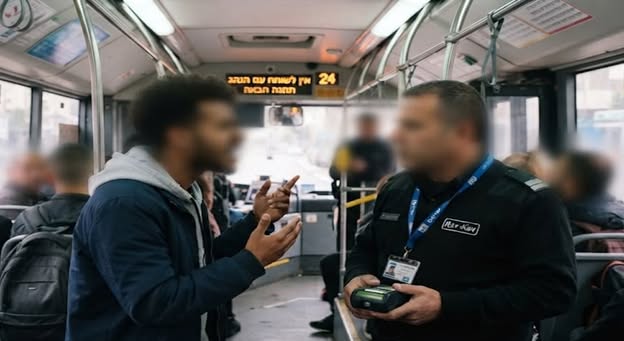
At that moment, I just froze. I stood there holding my phone, my heart racing, everyone staring at me, and not a single person saying a word.
Just a few minutes earlier, everything had been completely normal. I got on the bus, paid through the app, and sat down. Just another ordinary bus ride. I never imagined I would get off that bus feeling the way I did, carrying words that would stay with me long after the ride was over.
A few minutes into the journey, a ticket inspector boarded the bus, approached me, and asked to see proof of payment. I took out my phone and tried to open the app, but it simply wouldn’t load. I tried again and again, but nothing worked.
I told him, “Bro, I paid. The app is frozen. Just give me a moment and it’ll open.”
I spoke calmly. I didn’t shout, swear, or cause any trouble. All I asked was for him to wait a second.
But he had already decided I was lying.
He looked at me as if I were some kind of thief who had boarded the bus without paying. I tried to explain that I had absolutely no reason to lie to him, that the payment confirmation was on my phone, and that I would show him everything as soon as the app opened.
But he didn’t want to listen.
The more I tried to explain, the louder he became. Suddenly, everyone on the bus started watching. People stopped talking. Some stared directly at me, others looked down, and some pretended they couldn’t see what was happening.
Then, in a loud voice, right in front of everyone, he said:
“You Ethiopians, you’re all the same.”
I couldn’t believe what I was hearing.
I tried once again to explain that I had paid and that there was a problem with the app, but he cut me off and said:
“Come on, I don’t have time for you.”
And then he added the words I still can’t get out of my head:
“Come on, just another typical nigger.”
At that moment, I felt as though someone had punched me in the stomach.
I kept thinking to myself: What is wrong with you? Do you even know me? Do you know who I am? Just because the app wouldn’t open, you decided I was a liar? Just because I’m Ethiopian, you think you can speak to me however you want?
I honestly didn’t know how to react.
Part of me wanted to shout back at him and stand up for myself. Another part of me just wanted to disappear.
I felt deeply humiliated in front of an entire bus full of people.
He didn’t see me as a human being. He didn’t see a passenger having trouble with an app. To him, I was just another Ethiopian he could suspect, insult, and humiliate in front of everyone.
And what hurt me the most was that nobody said anything.
Everyone heard it. Everyone saw it. But not a single person told him, “Bro, stop. That’s not okay.”
Nobody said, “That’s no way to speak to another human being.”
Everyone simply remained silent.
A few minutes later, the app finally opened.
I showed him my payment confirmation, and everything was there. It was clear that I had paid before the bus ride even began.
I thought that now, at the very least, he would lower his head, apologize, or admit that he had been wrong.
But nothing.
Not even a single word.
As if he hadn’t just humiliated me in front of everyone. As if the things he had said didn’t matter. As if you could throw such hateful words at someone and simply carry on as though nothing had happened.
When I got off the bus, I was emotionally drained.
I was angry, hurt, and humiliated.
His words kept playing over and over in my head.
I couldn’t understand how, in 2026, someone could still experience something like this simply because they are Ethiopian, simply because of the color of their skin.
After the incident, I reached out to Tebeka, an organization that fights discrimination and promotes equal rights.
For the first time, I felt that someone was truly listening to me, standing by my side, and helping me defend my rights.
For me, this mattered not only because of what had happened to me, but because I wanted to make sure that the same thing wouldn’t happen to someone else.
I’m sharing my story because I know there are other children, teenagers, and adults who have experienced similar things and remained silent.
Maybe they were afraid.
Maybe they thought nobody would believe them.
Maybe they told themselves there was nothing they could do.
So I want to tell them something:
Do not stay silent.
And I also have something to say to everyone who witnesses racism.
Don’t look away. Don’t lower your head. Don’t keep scrolling through your phone as if nothing is happening.
Say something.
Even a simple sentence like, “Bro, that’s not okay,” can make a difference.
And most importantly, learn to stand up for your rights.
Document every incident and reach out to people and organizations that can help you.
You do not have to face this alone.