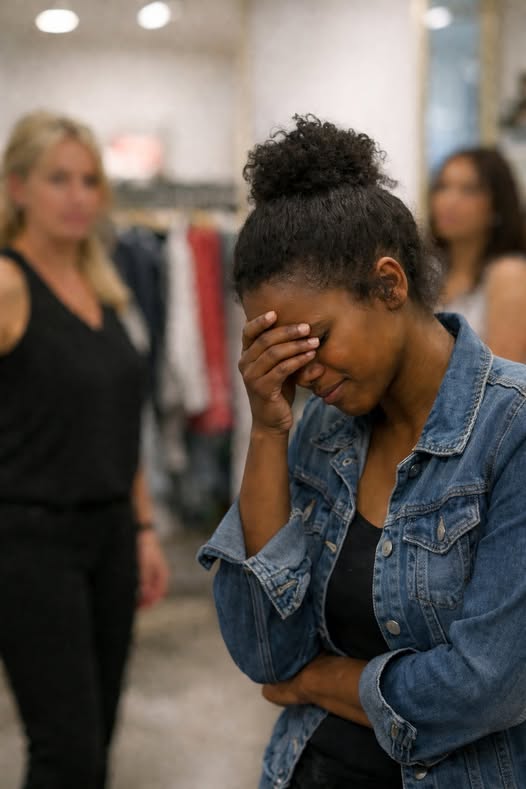
I entered a clothing store to make a simple purchase. Nothing unusual. An ordinary day, an ordinary need, a small moment of ordinary life. I wanted to choose a few items, try them on, ask the salesperson for some help, and leave. Like any customer entering a store, without thinking twice, without imagining that I would leave feeling humiliated.
From the very first moment, I felt that something was wrong.
I approached one of the saleswomen and asked for assistance. She looked straight through me and continued as if I had not spoken to her at all. I stood in front of her, waited, tried again, but she simply ignored me. No eye contact, no response, no basic acknowledgment. As if I did not exist. As if I were invisible.
I tried once more. Again, nothing.
Only after I explicitly asked whether she worked there and whether I could receive service did she finally turn to me. But even then, it was not to help. She answered coldly, “I’m busy,” although at that moment she was not busy at all, and muttered something to herself in a dismissive tone.
After I asked her again for help, and for no reason at all, it happened.
Instead of answering me, instead of offering the basic assistance that any salesperson is expected to provide, she threw words at me that have not left my heart since: “What are you even doing here, you stinking Ethiopian? Go back to Ethiopia.”
At that moment, I froze.
I stood there inside the store, among the clothes, in front of the mirrors, in front of other people, and I simply felt something inside me break. I could not answer. I could not move. I just stood there, my heart pounding, my throat tight, with a sense of humiliation that cannot truly be put into words.
But it did not end there.
While I was still in shock, completely stunned, unable to respond or even process what I had just heard, she added: “Stinking Black woman.”
At that moment, the humiliation became almost impossible to describe. It was no longer just an insult. It felt as though I was being erased as a person. As though she looked at me and saw not a woman, not a customer, not a human being, but a target for degradation, humiliation, and hatred.
I came to buy clothes. I did not come to argue. I did not come to ask for special favors. I only wanted basic service, human treatment, minimal respect. But in one moment, I was made to feel that I did not belong. As if my very presence there was a disturbance. As if I had to explain why I had entered the store at all. As if I was not a woman, not a customer, not a human being, but only a skin color, only an origin, only a target for humiliation.
And that is what is so cruel about racism.
Sometimes it does not begin with a slur. Sometimes it begins with being ignored. With contempt. With the decision that the person standing in front of you is not even worthy of a response.
And then, when the words are finally thrown in your face, they cut even deeper, because you understand that what you felt from the very first moment was true.
Since that moment, those sentences have not left me. They come back to me on the way home. They come back to me at night. They come back to me in quiet moments, when I try to understand how a person can allow herself to speak to another human being this way simply because of their origin.
Some injuries do not leave a mark on the body, but they remain deep in the soul. They shake your confidence. They break your sense of belonging. They leave pain, shame, and insult, even though the shame is not mine.
I understood that I could not let this pass in silence, and I turned to Tebeka. From the very first moment, they listened to me, believed me, and made me feel that I was not alone. I felt that someone saw my pain, that someone understood that a case like this must not be met with silence, and that someone was willing to fight so that this humiliation would not simply disappear as if it had never happened.
I know that I am not the only one. There are many others who experience moments just like this. Moments in which a stranger decides to humiliate them because of their origin, leaving them to pick themselves up from the floor.
But we must not remain silent. Silence does not heal the wound. It only allows it to grow deeper.
If you have experienced racism, humiliation, or discrimination, do not hesitate to contact Tebeka at 072-2424622.